Recording, Curation and Publication of Data in the Humanities
Research databases, recording systems and data curation
Surveying and photogrammetric feature documentation
Scientific cartography and data visualisation
Consulting for research proposals and recording workflows
datalino designs, develops and maintains the digital working environment of research projects in the humanities, museum collections and heritage authorities – from the proposal stage to the transfer of data into a repository. Field surveying, data management and cartographic production come from a single source and remain within one shared reference system.
Services
Research Databases and Recording Systems
For excavation, edition and collection projects, databases are built whose data model follows the documentation workflow: features, finds, photographs, drawings and survey data are recorded in the field and linked relationally; analysis, catalogues and publication templates are generated from the same dataset. Legacy holdings from card indexes, spreadsheets and older applications are analysed, migrated and merged.
Surveying for Excavation and Heritage Conservation
Establishment, verification and maintenance of control point networks, station setup and measurement with total station and GNSS, control points for photogrammetry and remote sensing. Every campaign includes checking the existing network and instruments, as well as a measurement record documenting reference system, method and achieved accuracy – the precondition for reliably merging data from several campaigns at a later stage.
Photogrammetry and 3D Documentation
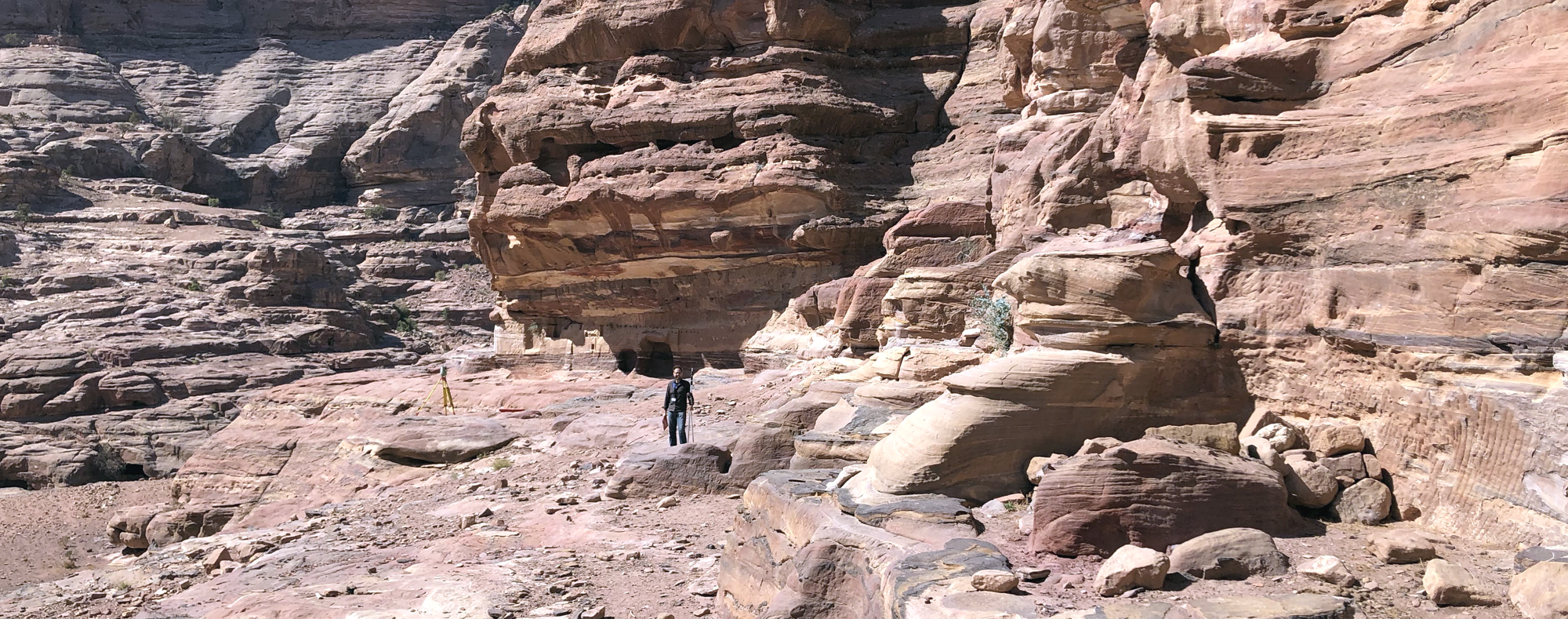
Image-based recording of individual features, sections and architecture as well as large-scale terrain models, processed with Agisoft Metashape: orthophotos and elevation models as a basis for plan and section drawing, textured models for analysis, archiving and outreach. This includes aerial imagery – captured with a dedicated drone in Oymaağaç, Qatar, Fujairah and Petra, elsewhere provided by project staff on site, as the import of aircraft is restricted in many countries. Processing, georeferencing and integration into a shared reference system are carried out in-house in every case, and results can be used directly in GIS and database applications.
Data Curation
Heterogeneous holdings are cleaned, normalised and documented: controlled vocabularies and classifications, links to authority files (GND, Geonames, iDAI.gazetteer), persistent identifiers, consistent place, date and measurement formats, provenance and processing status. The aim is a dataset that is citable and reusable, complies with the FAIR principles, and retains its structure when exported to exchange formats.
Scientific Cartography and Data Visualisation
Overview, distribution and feature maps for monographs and journals, interactive map applications for online portals, plates and diagrams for atlases and exhibitions. Based on georeferenced data from surveying, remote sensing and published literature.
Consulting
Data management plans and digital work packages for proposals to DFG, ERC, BMBF and foundations, including costing, roles and responsibilities. Analysis of recording workflows and institutional processes: which unit records which information, in which system, at which level of detail. Mediation between academic departments, IT units and service providers, including support in preparing procurements.
Operation and Handover
Hosting, maintenance and further development beyond the funding period, coordinated with university libraries, computing centres and subject repositories. Every system comes with a documented data model, exports in open, non-proprietary formats, and handover routines – so that the data outlives the project and a change of service provider is possible without loss of substance.
datalino is run by Christoph Forster. For larger projects, colleagues from IT consulting, development and graphic design join the team.
Maps and Graphics
-
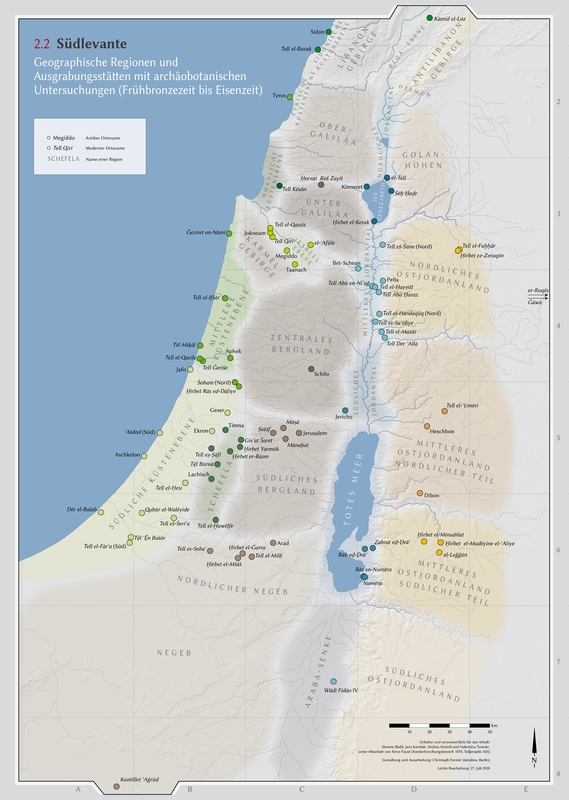 Southern Levant: Regions and Archaeobotanically Investigated Sites
-
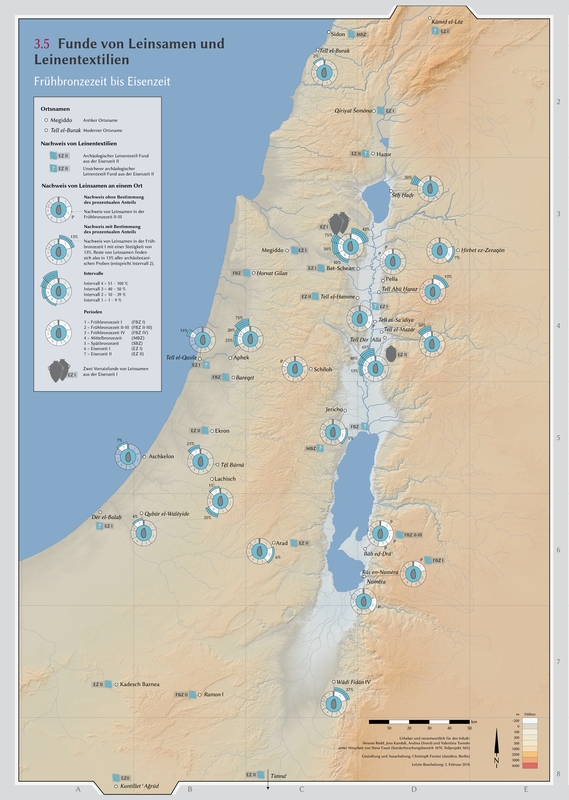 Finds of Flax Seeds and Linen Textiles
-
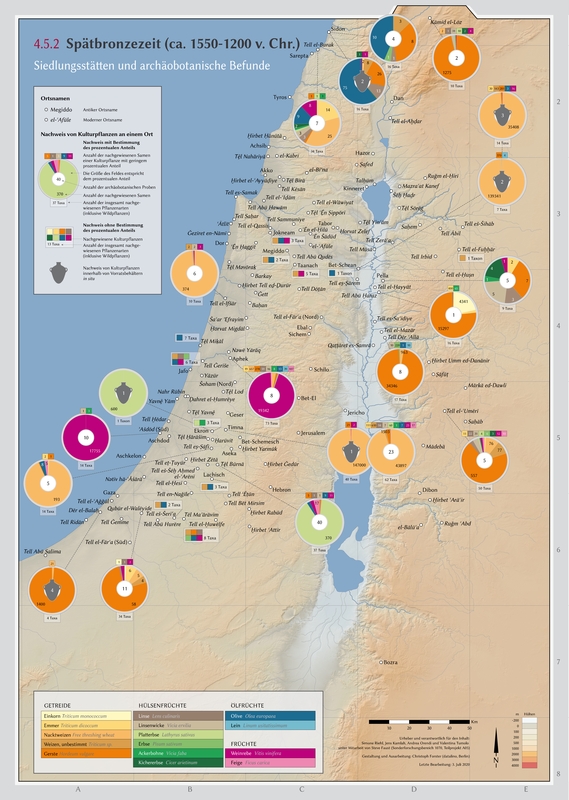 Late Bronze Age Settlements and Archaeobotanical Evidence
Cartography and digitisation: datalino, for subprojects A05 and A06 of Collaborative Research Centre 1070 RessourcenKulturen (Resource Cultures) of the German Research Foundation (DFG), University of Tübingen (Institute for Archaeological Sciences – Archaeobotany, PD Dr. Simone Riehl; Institute for Biblical Archaeology, Prof. Dr. Jens Kamlah). Full project titles are listed under References. Images open at full resolution in a new tab.
Clients
A selection of institutions and projects that datalino has worked and continues to work for. Selected projects are described in more detail under References.
Research Networks and Funding Programmes
- Cluster of Excellence Cross-Cultural Philology, Ludwig-Maximilians-Universität München
- Cluster of Excellence Topoi “The Formation and Transformation of Space and Knowledge in Ancient Civilizations”
- Priority Programme 2176 of the German Research Foundation (DFG) “The Iranian Highlands: Resilience and Integration in Pre-Modern Societies”
- Collaborative Research Centre 933 of the German Research Foundation (DFG) “Material Text Cultures. Materiality and Presence of Writing in Non-Typographic Societies”, Heidelberg University
Universities and Research Institutions
- Department of Westphalian Regional History, Historical Seminar, University of Münster
- German Archaeological Institute (DAI)
- Institute for Classical Studies, University of Würzburg
- Institute for Ancient Near Eastern Philology and History, Freie Universität Berlin
- Institute for Near Eastern Archaeology, Freie Universität Berlin
- Institute for Ancient Near Eastern Studies and Near Eastern Archaeology, University of Münster
- Institute for Classical Archaeology and Christian Archaeology, University of Münster
- Institute for Biblical Archaeology, Eberhard Karls University Tübingen
- Institute for Archaeological Sciences and Archaeobotany, Eberhard Karls University Tübingen
Archaeological Research Projects
- Armenian-German Artaxata Project (Armenia), University of Münster
- New Archaeological Research at Assur (Iraq), Ludwig-Maximilians-Universität München
- Oymaağaç-Nerik (Turkey), Freie Universität Berlin, Uşak University
- The Cultural Landscape of Al-Faw Archaeological Area (Saudi Arabia)
- Fujairah-German Archaeological Project (United Arab Emirates), German Archaeological Institute
- The Peshdar Plain Project (Iraq, Kurdistan Region), University of Münster
- Excavation Project at Gird-i Rostam (Iraq, Kurdistan Region), Ludwig-Maximilians-Universität München
- Telling Stones – Megaliths on Sumatra (Indonesia), Freie Universität Berlin
- Tell Ushayer (Jordan), Freie Universität Berlin
- Tell Sheikh Hamad (Syria), Freie Universität Berlin
Museums, Authorities and Associations
- German Oriental Society (DOG)
- German Association for Archaeology (DVA)
- German Historical Museum, Berlin
- Amalien Organ Support Association, Berlin
- Kulturstiftung der Länder (German Cultural Foundation of the Federal States)
- Landesdenkmalamt Berlin (Berlin State Office for Historic Preservation)
- National Museums in Berlin – Prussian Cultural Heritage Foundation
- Humboldt Forum Foundation in the Berlin Palace
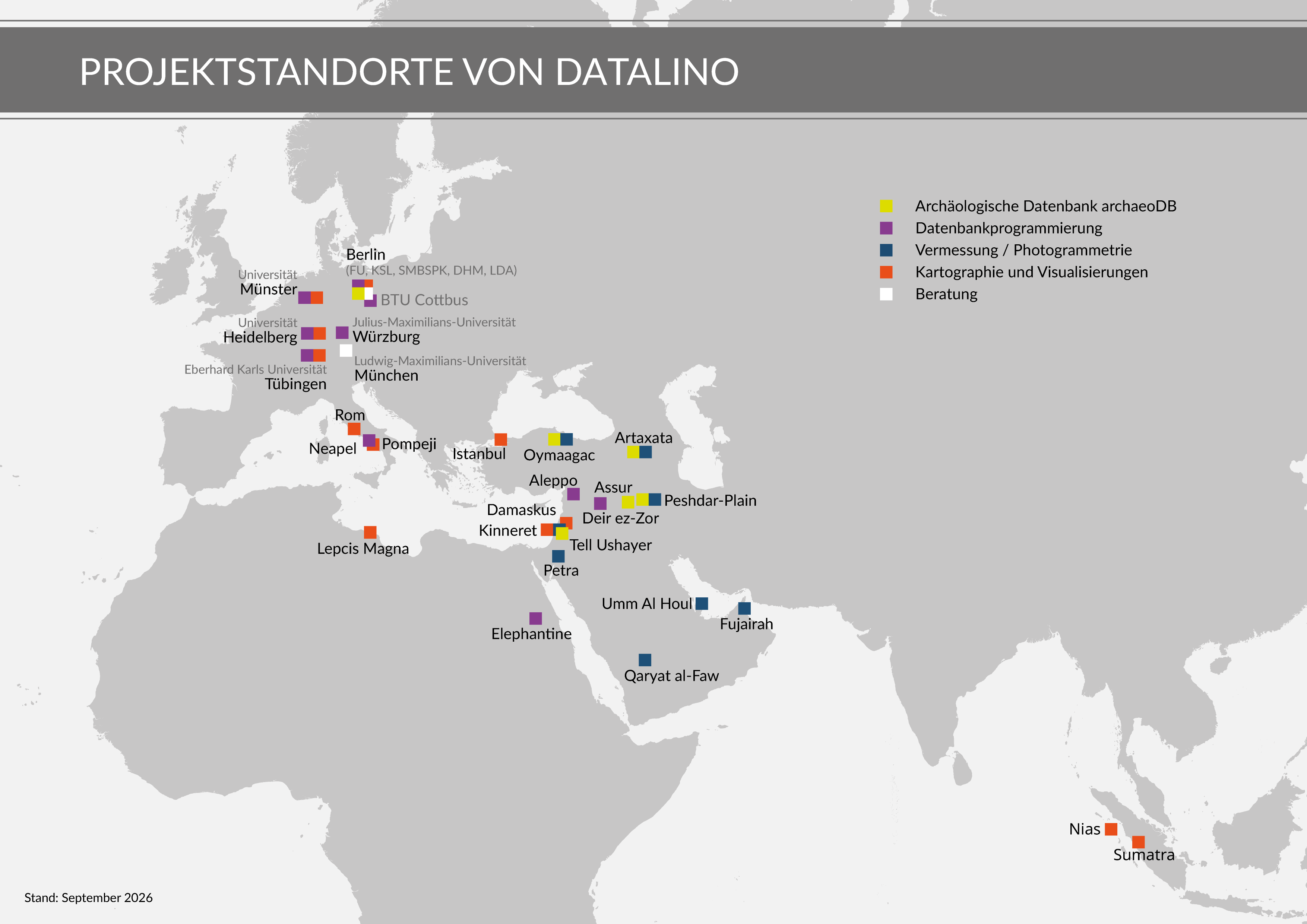
Project Locations
Surveying, data management, data curation, consulting and cartography at a glance. Click on the map for a larger view. More detailed information on individual projects can be found under References.
Selected References
- Creation of a digital edition / web presentation of the Koelhoff Chronicle – Koelhoffsche Chronik 1499 digital
Department of Westphalian Regional History, Historical Seminar, University of Münster, Prof. Dr. Carla Meyer-Schlenkrich
https://www.uni-muenster.de/Geschichte/histsem/LG-G/Forschen/koelhoffschechronik.shtml - Development of a web-based database for the DFG project: Buildings of the Allied Occupation Period in Western Germany 1945–1955
Brandenburg University of Technology Cottbus–Senftenberg, Chair of Heritage Conservation, Dr. Antoine Beaudoin, Prof. Dr. Johanna Blokker - Data management and consulting for Priority Programme 2176 of the German Research Foundation (DFG) “The Iranian Highlands: Resilience and Integration in Pre-Modern Societies”
Ruhr University Bochum, Institute of Archaeological Sciences / German Mining Museum Bochum, Prof. Dr. Thomas Stöllner
https://iranhighlands.com/ - Surveying as well as creation and maintenance of the documentation database for the Armenian-German Artaxata Project
University of Münster, Institute for Classical Archaeology and Christian Archaeology, Prof. Dr. Achim Lichtenberger
Armenian-German Artaxata Project - Creation and maintenance of the documentation database for the research project: New Archaeological Research at Assur
Faculty of History and the Arts, Historical Seminar – Ancient History, Ludwig-Maximilians-Universität München, Prof. Dr. Karen Radner
New Archaeological Research at Assur - Creation of an exhibition planning database
German Historical Museum, Berlin, Prof. Dr. Raphael Gross - Creation of the database of Benin Bronzes in Germany for the Contact Point for Collections from Colonial Contexts in Germany
Kulturstiftung der Länder (KSL)
Prof. Dr. Markus Hilgert, María Leonor Pérez Ramírez
https://www.cp3c.org/benin-bronzes/ - Business process analysis, consulting, programming
Kulturstiftung der Länder (KSL)
Deputy Secretary General, Prof. Dr. Frank Druffner - Creation and maintenance of the documentation database for the archaeological research project Excavation in Tell Ushayer (Jordan)
Freie Universität Berlin, Institute for Near Eastern Archaeology
Prof. Dr. Dominik Bonatz - Database for the research project Hittite Local Cults
University of Würzburg, Chair of Ancient Near Eastern Studies
Prof. Dr. Daniel Schwemer, Dr. Michele Cammarosano
https://www.hethport.uni-wuerzburg.de/HLC/ - Data curation and set-up of a web-based documentation for the research project Telling Stones – Megaliths on Sumatra
Freie Universität Berlin, Institute for Near Eastern Archaeology
Prof. Dr. Dominik Bonatz - Consulting for the Digital Department of Humboldt Forum Kultur GmbH
Humboldt Forum Foundation in the Berlin Palace
Prof. Dr. Hartmut Dorgerloh, Lavinia Frey
https://www.humboldtforum.com - Consulting and programming
museum4punkt0. Digital strategies for the museum of the future at the National Museums in Berlin (SMB) – Prussian Cultural Heritage Foundation (SPK)
Prof. Dr. Markus Hilgert
https://www.museum4punkt0.de - Creation and maintenance of the documentation database for the archaeological research project Excavation in Gird-i Rostam (Iraq, Kurdistan Region)
New York University, Institute for the Study of the Ancient World, Prof. Dr. Dan Potts - Creation and maintenance of the documentation database, production of orthophotos and management of the survey network for the archaeological research project The Peshdar Plain Project. Exploring a Neo-Assyrian Border March to Iran (Iraq, Kurdistan Region)
University of Münster, Ludwig-Maximilians-Universität München
Prof. Dr. Janoscha Kreppner, Prof. Dr. Karen Radner
LMU Munich project page - Consulting and programming, Centre for Digital Cultural Heritage in Museums (ZEDIKUM) at the National Museums in Berlin (SMB) – Prussian Cultural Heritage Foundation (SPK)
Prof. Dr. Markus Hilgert
https://www.zedikum.de - Design of the data management concept and development of the database, as well as publication of an Illustrated List of Objects, for the project Digitizing the Inventory of the Museum of Deir ez-Zor (Syria)
Freie Universität Berlin, funded by the German Federal Foreign Office, Prof. Dr. Hartmut Kühne
https://www.museumdeirezzor.org - Digitisation and map production for subprojects A05 “The Land of Milk and Honey”: Development and Significance of Agricultural Resources in Bronze and Iron Age Palestine, and A06 Political Collapse as a Consequence of Economic Change? Resource Control during the Transition from the Bronze to the Iron Age in the Eastern Mediterranean
Collaborative Research Centre 1070 of the German Research Foundation (DFG): RessourcenKulturen
University of Tübingen, Institute for Archaeological Sciences – Archaeobotany, PD Dr. Simone Riehl; Institute for Biblical Archaeology, Prof. Dr. Jens Kamlah
https://archaeodb.de/a05-agriculture/ - Digitisation and map production for the Museum of the Ancient Near East, Berlin
National Museums in Berlin – Prussian Cultural Heritage Foundation
Prof. Dr. Markus Hilgert - Data management, website and databases for Collaborative Research Centre 933 of the German Research Foundation (DFG) “Material Text Cultures”
Heidelberg University, Spokesperson: Prof. Dr. Ludger Lieb
https://www.materiale-textkulturen.de - Surveying, 3D feature recording, data management for the research project Fujairah German Archaeological Project (United Arab Emirates)
German Archaeological Institute, Fujairah Tourism & Antiquities Authority, Government of Fujairah
Dr. Kristina Pfeiffer, Prof. Dr. Ricardo Eichmann
DAI project page - Surveying, 3D feature recording, data management for the research project Umm el-Houl: A Threatened 19th-Century Coastal Settlement (Qatar)
German Archaeological Institute, Qatar Museums
Dr. Kristina Pfeiffer, Prof. Dr. Ricardo Eichmann, Dr. Thomas Leisten
DAI project page - Data management and interactive maps for the research project Place Names in the Book of Genesis
Faculty of Theology, Heidelberg University, Prof. Dr. Jan Christian Gertz, Prof. apl. Dr. Detlef Jericke
https://www.odb.bibelwissenschaft.de - Data management and interactive maps for the research project Archaeobotanical Database of Eastern Mediterranean and Near Eastern Sites (ADEMNES)
University of Tübingen, Institute for Archaeological Sciences – Archaeobotany, PD Dr. Simone Riehl - Data management, CAD and GIS support for the research project Tell Fecheriye (Syria)
Freie Universität Berlin, Prof. Dr. Dominik Bonatz - Website of the German Oriental Society
https://www.orient-gesellschaft.de - Website of ex oriente e. V., Dr. Hans-Georg Gebel
https://www.exoriente.org - Interactive Atlas of the Ancient Near East, Cluster of Excellence Topoi
Freie Universität Berlin, Prof. Dr. Eva Cancik-Kirschbaum, Prof. Dr. Jörg Klinger - Excavation at Oymaağaç: website, documentation database, open-access publication
Freie Universität Berlin, Prof. Dr. Jörg Klinger
https://www.nerik.de - Excavation at Tell Sheikh Hamad (Syria)
Freie Universität Berlin, Prof. Dr. Hartmut Kühne
https://www.schechhamad.de
Contact
Christoph Forster – datalino
Martin-Luther-Straße 120, 10825 Berlin, Germany
Email: forster@datalino.de
Phone: +49 30 78 89 32 32
Publications
- Éric Robert, Marie-Anne Julien, Laurent Crépin, Stéphane Petrognani, Laëtitia Demay et al.: Regards croisés entre productions graphiques et faunes des sites du Magdalénien moyen et supérieur de la vallée de la Vézère (Dordogne, France). In: Hiatus, lacunes et absences: identifier et interpréter les vides archéologiques. Actes du 29e Congrès préhistorique de France, 31 mai – 4 juin 2021, Toulouse, Session Manifestations artistiques et symboliques. Société préhistorique française, pp. 5–26, 2024. hal-04649772
- Rainer Maria Czichon, Jörg Klinger, Pavol Hnila, Dirk Paul Mielke et al.: Archäologische Forschungen am Oymaağaç Höyük/Nerik 2016–2018. In: Mitteilungen der Deutschen Orient-Gesellschaft zu Berlin (MDOG) 151, pp. 1–164, 2019